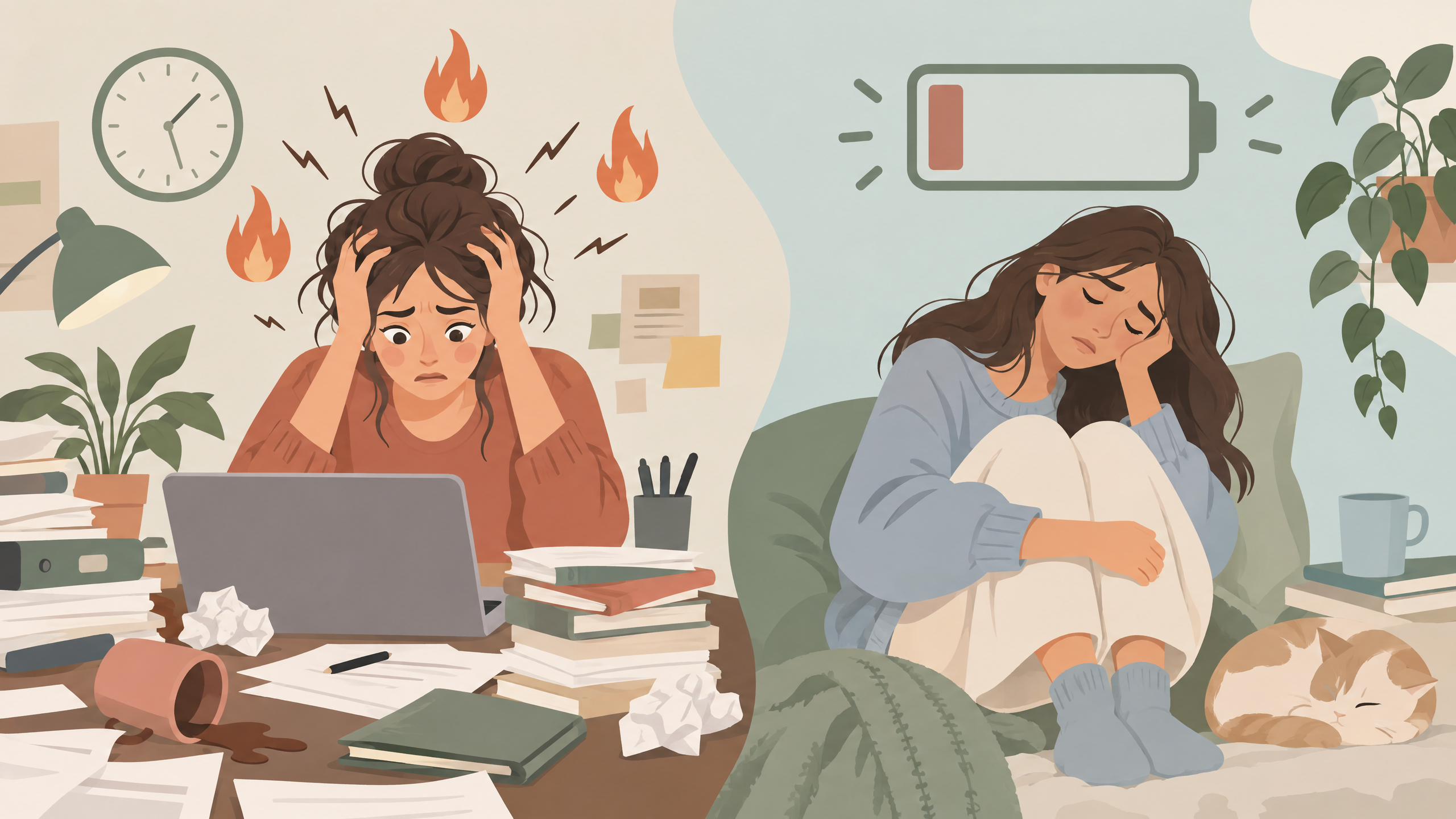
“I’m burned out” has become casual language for feeling tired or stressed. But clinical burnout is a specific and serious condition — distinct from ordinary work stress in important ways, and requiring a meaningfully different response.
Treating burnout like stress, or stress like burnout, wastes time and often makes things worse. Here’s how to tell them apart.
What Stress Actually Is
Stress is a state of physiological and psychological activation in response to demand. It’s characterised by urgency, pressure, and a sense that you have too much to deal with. In stress, the underlying drive is typically a sense that things matter intensely — that there’s something at stake that you care about.
Stress is uncomfortable, but it’s not inherently pathological. Short-term stress improves performance on many tasks. It’s only when stress is chronic and unrelieved — when there’s never recovery, never enough rest, never a sense of completion — that it starts to damage health and functioning.
A stressed person often thinks: “If I could just get through this week / project / period, I’d be fine.”
They’re right — and that’s the distinction. Stress is a resource-demand imbalance that rests can repair.
What Burnout Actually Is
Burnout is a different animal. The World Health Organisation classifies it as an “occupational phenomenon” characterised by three dimensions:
- Exhaustion — not just tiredness but a bone-deep depletion that doesn’t respond to normal rest
- Cynicism and detachment — distance, negativity, or indifference toward work you used to care about
- Reduced efficacy — a sense that you can’t do your job properly anymore, regardless of how much effort you put in
The critical difference: burnout is a state of depletion where recovery is not straightforward. A week off doesn’t fix it. A good night’s sleep doesn’t fix it. The burned-out person often comes back from annual leave still exhausted.
A burned-out person often thinks: “Nothing I do makes any difference. I don’t care anymore. I used to love this work and now I can’t stand it.”
The loss of meaning and the indifference are diagnostic. Stressed people still care. Burned-out people often can’t.
The Burnout Spectrum
Burnout doesn’t appear overnight. It develops through recognisable stages:
Stage 1 — Enthusiastic overextension. High commitment, going above and beyond, not prioritising rest. This often feels like a productive, motivated period.
Stage 2 — Stagnation. The output continues but the enthusiasm fades. Work starts to feel less rewarding. You notice you’re more irritable and less energised by things that used to engage you.
Stage 3 — Frustration. You begin questioning the value of your work. Cynicism grows. Small problems feel disproportionately significant. You may feel underappreciated or stuck.
Stage 4 — Apathy. Emotional withdrawal from work and sometimes from relationships. Chronic exhaustion. Physical symptoms (headaches, illness, digestive problems) become more frequent.
Stage 5 — Burnout. Complete emotional and physical depletion. Inability to function at work. This stage often looks indistinguishable from depression and requires professional support.
The Maslach Burnout Inventory
The Maslach Burnout Inventory (MBI), developed by Christina Maslach at UC Berkeley, is the most widely used and validated burnout assessment tool. It measures the three dimensions (exhaustion, cynicism, efficacy) separately, giving a more nuanced picture than a single score.
The MBI is available through psychology providers. There are also free shorter versions online that give a reasonable approximation. If you’re wondering which side of the burnout-stress line you’re on, a formal assessment is more reliable than self-diagnosis.
How Recovery Differs
For stress:
- Rest, sleep, and genuine recovery time
- Reducing workload or increasing resources
- Addressing the source of the demand where possible
- Stress management techniques like exercise, mindfulness, and breathing practices
- Timeline: days to weeks
For burnout:
- Extended rest — often several weeks minimum, not just a long weekend
- Significant reduction in responsibilities, not just “taking it easy”
- Medical support if symptoms are severe
- Rebuilding meaning and connection to values — which requires reflection, not just rest
- Addressing systemic causes (toxic workplace culture, unsustainable workload, lack of autonomy) or changing the environment
- Timeline: months, sometimes longer
The key message: burnout cannot be treated with the same tools as stress. More coffee, better productivity systems, and positive thinking don’t address depleted emotional resources. They often accelerate burnout.
What to Do If You Think You’re Burned Out
First: Name it accurately. Burnout is not a personal failing. It’s a predictable response to sustained resource-demand imbalance in a specific environment.
Second: Assess severity. If you’re in early stages (stagnation or frustration), lifestyle changes and work adjustments may be enough. If you’re in later stages (apathy, complete depletion), professional support is important.
Third: Rest genuinely. This means not checking email on annual leave. Not “working from home” while sick. Not listening to work podcasts during exercise. Real rest.
Fourth: Address the systemic cause. If the environment that caused burnout doesn’t change, returning to it unchanged will produce the same result. This might mean having a difficult conversation about workload, setting firmer boundaries, or in some cases, deciding the environment itself is not recoverable.
For work-life balance strategies and longer-term wellbeing maintenance, see our related guides. And if you’re not sure whether what you’re experiencing is stress or burnout, take our wellbeing assessment as a starting point.