Remote work promised flexibility and freedom. For many people, it delivered something else: a permanent state of partial work — never fully at work, never fully off. The commute that once served as a transition ritual is gone. The physical boundary between office and home is gone. And the cultural expectation that you’re “always available” because you’re technically at home has crept in for many workers.
The result is that burnout rates among remote workers are often higher than for office workers, not lower. The flexibility that remote work offers is only a wellbeing benefit if you actually use it to build better boundaries — not if it just means you work longer.
Here’s how to protect yourself.
The Core Problem: Blurred Transitions
The commute was never just transport. It was a twice-daily ritual that told your brain: “work mode is starting” and “work mode is ending.” Without it, many remote workers stay in a low-grade work state all day — not fully focused during work hours, not fully relaxed outside them.
The solution is deliberate transition rituals: small actions that signal the psychological shift between work mode and personal mode.
Morning transition: A short walk before sitting down to work (even 10 minutes around the block). Getting dressed as if you were going to an office. Making coffee and drinking it somewhere other than your desk before logging on.
Evening transition: A “shutdown complete” ritual — a specific sequence of actions that closes the workday. Writing tomorrow’s top three priorities, closing all work tabs, saying out loud “shutdown complete” (yes, this sounds ridiculous — it works anyway), then a brief walk or other physical transition. The ritual itself matters less than its consistency.
Set Your Hours — and Protect Them
This sounds obvious but is regularly violated: define your working hours and treat them as fixed commitments, not as flexible defaults to extend when convenient.
Most remote workers expand into available time naturally, without deciding to. They check email at 9pm “just quickly.” They respond to a message on Saturday because they happened to see it. They stay late because the commute time they saved has to go somewhere, right?
It doesn’t. That time is yours.
Define your hours. Set your status to offline when they end. Close your work laptop. Set up email scheduling if necessary so replies don’t go out at 10pm and set an implicit expectation that you’re available at 10pm.
Designate Work and Non-Work Spaces
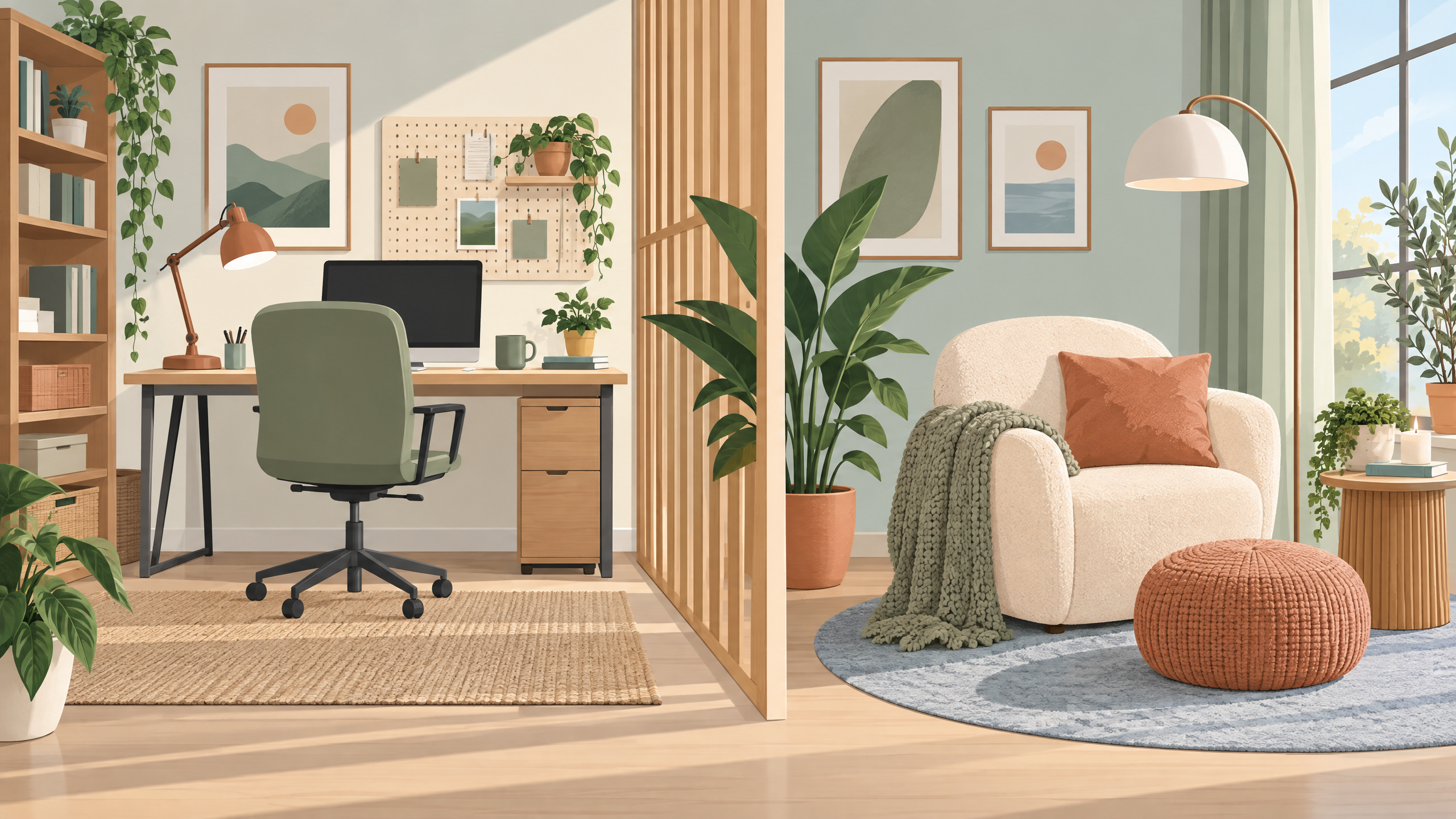
If you have room for it, work from a single dedicated space — ideally a room with a door. When you’re in that space, you’re working. When you’re not, you’re not.
If you live in a small space where this isn’t possible: work from the same spot at the same table, and when work ends, deliberately change something physical about the space. Close the laptop. Move the chair. Put the notebook in a drawer. The visual change signals to your brain that the context has shifted.
Never work from bed. The association between your bed and alertness and work activity genuinely degrades sleep quality.
Protect Your Breaks
Breaks during the workday are not a luxury — they’re a performance tool. Research on deliberate practice consistently shows that focused work in 90-minute intervals followed by genuine rest (not checking social media — actual rest) produces more output than extended low-focus sessions.
Schedule your breaks and protect them as you would a meeting:
- Leave your desk for at least 30 minutes at lunch
- Step outside during at least one break per day
- Do not eat lunch at your keyboard
The hardest part of remote work breaks is the guilt. In an office, breaks are visible and normalised. Working from home, breaks can feel like cheating. They’re not — they’re how you sustain output through an eight-hour day.
Manage Communication Expectations
Much of remote work stress comes from the expectation of constant availability. Address this directly:
- Set explicit response time expectations with your team (e.g., you respond to Slack within two hours during working hours, not instantly)
- Turn off work notifications outside working hours — not on silent, fully off
- Use asynchronous communication where possible rather than defaulting to real-time messaging for everything
- If your organisation’s culture expects instant responses at all hours, that’s a systemic issue worth naming explicitly
Protect Social Connection
One of the most significant wellbeing risks of remote work is the erosion of casual social connection — the brief conversations, shared lunches, and spontaneous interactions that happen naturally in offices. Over months, their absence creates a subtle but significant loneliness.
Counteract this deliberately:
- Schedule video calls with colleagues for non-work conversation, not just task-focused meetings
- Work from a coffee shop or coworking space one or two days per week if possible
- Protect social plans outside work hours — it’s easy to let them slide when you’re tired from a demanding day
Remote isolation is one of the most common contributors to poor wellbeing among home workers. Prioritise it.
Track Your Actual Hours
Most remote workers don’t know how many hours they actually work. They have a general sense of “a lot,” but no specific number.
Track your hours for two weeks using a simple timer or time-tracking app. The result is usually surprising — most people discover they’re working 10–20% more hours than they think, concentrated in the evenings and weekends.
The data gives you something concrete to make decisions about, rather than vague discomfort.
When to Escalate
If you’ve tried these strategies and still feel unable to disconnect, chronically exhausted, or have lost interest in things outside of work, you may be further into burnout territory than work-life balance strategies can address alone.
Measure your wellbeing with the WHO-5 index. If your score is below 50, speak to a healthcare professional. Work-life balance is a lifestyle adjustment; burnout is a recovery process.
The boundary between work and the rest of your life doesn’t enforce itself. In remote work, you have to build it and maintain it actively. But when you do, remote work genuinely can offer the flexibility and quality of life it was supposed to.