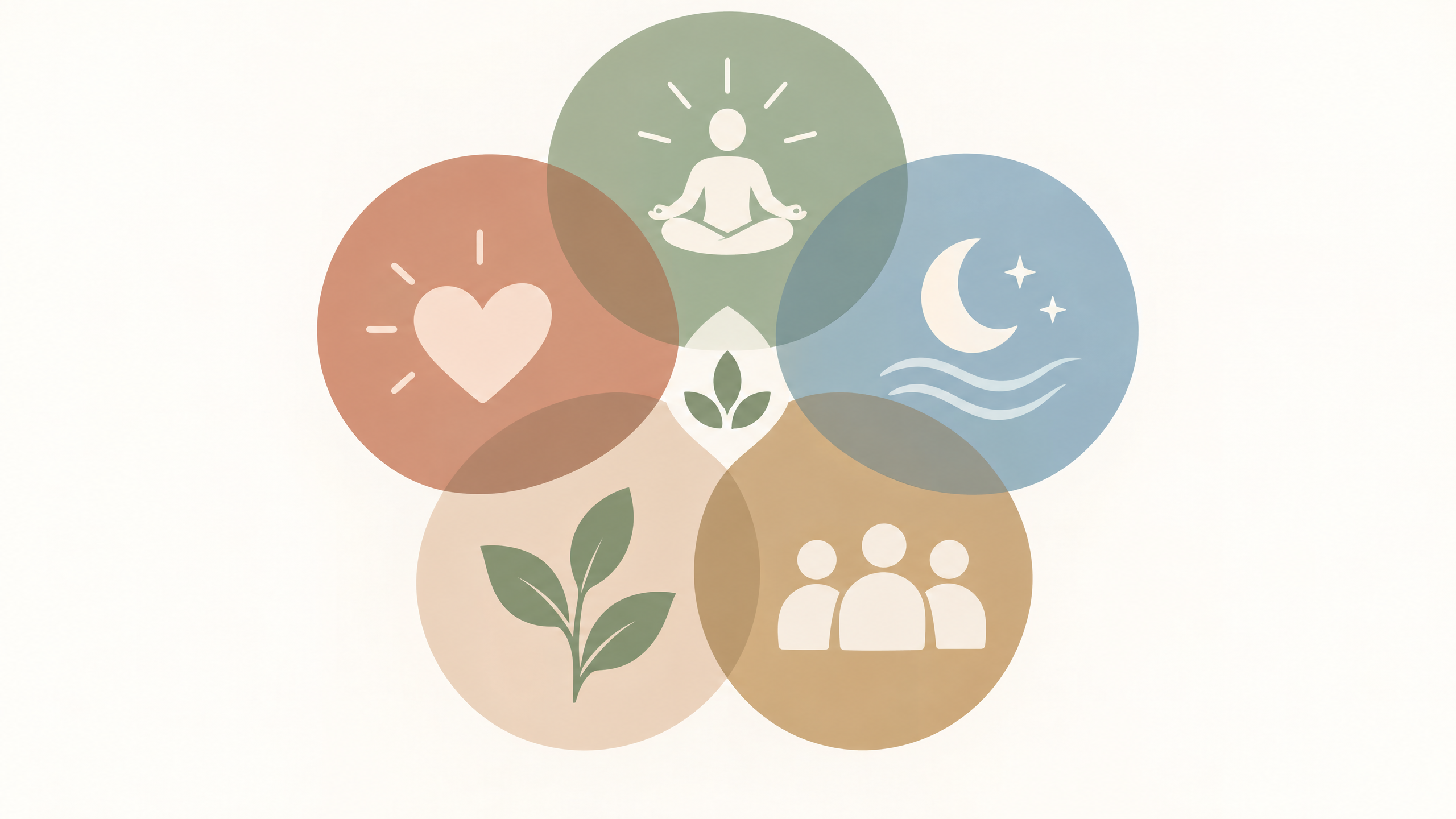
Wellbeing isn’t one thing. It’s a system of interconnected dimensions — and when one area weakens, the others feel the pressure too. Understanding what those dimensions are gives you a map for figuring out exactly where to focus.
Most researchers and wellbeing frameworks (including the National Wellbeing Framework and the PERMA model) converge on five core dimensions. Here’s what each one means, and what actually works for improving it.
1. Physical Wellbeing
Physical wellbeing means having the energy, strength, and vitality to move through daily life without your body being a barrier. It includes sleep quality, movement, nutrition, and the absence of chronic pain or illness — but it’s not about being an athlete or following a perfect diet.
What the evidence shows matters most:
- Sleep is the single most powerful physical wellbeing lever. Seven to nine hours per night affects everything from immune function to emotional regulation to cardiovascular health.
- Movement doesn’t require a gym. Thirty minutes of brisk walking five days a week reduces all-cause mortality risk by around 35% according to WHO research.
- Nutrition basics (eating mostly whole foods, limiting ultra-processed food, staying hydrated) outperform almost any specific diet plan.
Where to start: If your energy is low, fix sleep before anything else. No exercise programme compensates for chronic sleep deprivation.
2. Emotional Wellbeing
Emotional wellbeing is your capacity to understand, manage, and express your emotions constructively. It doesn’t mean always feeling positive — it means you can sit with difficult feelings without being overwhelmed by them, and return to a stable baseline after setbacks.
People with strong emotional wellbeing are more resilient, more productive, and have better relationships. They also tend to make better decisions under pressure.
What actually helps:
- Journalling consistently reduces emotional distress and helps people process difficult experiences. Even 15 minutes three times a week has measurable effects.
- Mindfulness practices build the capacity to observe thoughts and feelings without being controlled by them. Mindfulness meditation is one of the most researched interventions in psychology.
- Therapy is effective — particularly cognitive behavioural therapy (CBT) for anxiety and depression, and acceptance and commitment therapy (ACT) for emotional regulation more broadly.
Where to start: Practice naming your emotions precisely. Research by Matthew Lieberman at UCLA found that labelling a feeling reduces its intensity in the brain almost immediately.
3. Social Wellbeing
Social wellbeing is the quality of your relationships and your sense of belonging. This is one of the most powerful predictors of longevity — the Harvard Study of Adult Development (which followed participants for over 80 years) found that close relationships are the single strongest predictor of health and happiness in later life.
Loneliness is now classified as a public health crisis in several countries, with health impacts comparable to smoking 15 cigarettes a day.
What helps:
- Depth over breadth. A small number of close, trusting relationships matters more than a large social network.
- Regular, low-effort connection — a short call, a message, coffee with a friend — is more protective than infrequent grand gestures.
- Community belonging through shared interest groups, volunteering, or faith communities provides powerful social buffering.
Where to start: Identify one relationship you’ve been neglecting and reach out this week. Consistency over time is what builds the deep connections that protect wellbeing.
4. Occupational Wellbeing
Occupational wellbeing refers to the satisfaction, meaning, and sense of purpose you get from your work — broadly defined. This includes paid employment, caregiving, volunteering, or any activity that gives your time structure and contribution.
Work takes up a significant portion of waking life. When that time feels purposeless, draining, or chronically stressful, it degrades every other dimension of wellbeing. Burnout is the extreme end of this spectrum.
What builds occupational wellbeing:
- Autonomy — having some control over how and when you do your work
- Mastery — learning and growing in your role
- Meaningful contribution — feeling your work matters to someone or something
- Manageable workload with adequate recovery time
Where to start: If work is currently your main wellbeing drain, read our guide on work-life balance when working from home — the strategies there apply to office workers too.
5. Financial Wellbeing
Financial wellbeing doesn’t mean being wealthy. It means having enough financial stability that money isn’t a constant source of anxiety, and feeling a sense of control over your financial situation.
Research consistently shows that financial stress is one of the biggest drivers of poor mental health — not because of absolute income levels, but because of uncertainty and the feeling of being out of control.
What helps:
- A basic emergency fund (even a small one) dramatically reduces financial anxiety
- Understanding where your money goes each month (a simple budget, not a complex spreadsheet)
- Separating money decisions from emotional states — avoid making significant financial decisions when stressed
Where to start: Financial wellbeing often improves most quickly with knowledge, not income. Understanding the basics of personal finance reduces anxiety almost regardless of income level.
The Interconnected System
These five dimensions don’t exist in isolation. Poor sleep (physical) makes it harder to manage emotions (emotional). Financial stress strains relationships (social). Burnout at work (occupational) often triggers depression (emotional) and social withdrawal (social).
This is actually good news: improving one dimension tends to lift others. Physical exercise improves mood. Strong social connections buffer financial stress. Emotional regulation makes difficult work more manageable.
Start with whichever dimension feels most depleted. Use our wellbeing assessment tools to get a clearer picture of where you stand — and then build from there.